
2,000 Digital Ships: Validating Fleet-Scale Emissions Modelling Against EU MRV Data
March 2026
HullPIC Conference, Pontignano, Italy
Ship performance modelling is well proven at the single-vessel level. The real question for the industry is whether it holds up at scale, across thousands of ships, multiple years, and the messy reality of commercial fleet data. Our latest research, co-authored with Hermess and the Royal Netherlands Meteorological Institute (KNMI), puts that question to the test.
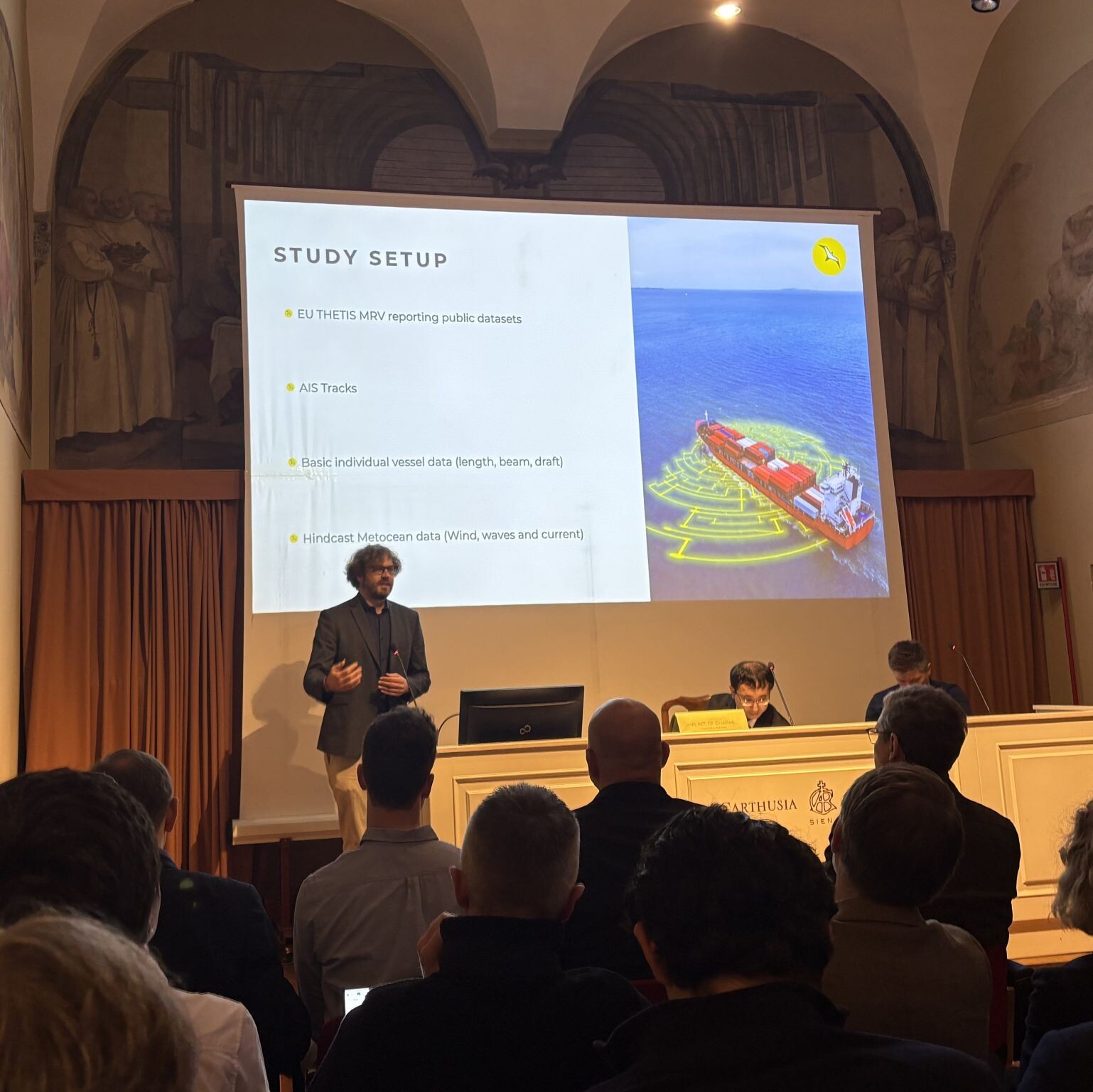
Starting from over 21,000 vessels in the EU THETIS-MRV reporting system, we built a fully automated pipeline that constructs a digital ship model from nothing more than public vessel particulars and AIS-derived voyage history. No manual tuning per ship. Each model was then run through six years of historical voyages (2018 to 2023), covering more than 1,600 ship-years, 82,000 voyages and 73 million nautical miles sailed, to estimate fuel consumption and CO2 emissions.
The results were then benchmarked against official MRV reporting, treated not as ground truth but as an independent reference dataset.
Key findings:
- Simulated fuel consumption matched reported MRV data with a median discrepancy of just 2.9%
- Across the fleet, the spread was a 1-sigma deviation of 31.9%, in line with expectations for real-world, self-reported data at this scale
- Accuracy varied by ship type, with bulk carriers and container ships showing the tightest match
- Newer vessels showed better agreement than older ones, a signal for building age-based corrections into future modelling
- A portion of the spread traces directly to inconsistencies in AIS-reported voyage distances rather than the ship models themselves
Beyond validating the modelling approach itself, the study points to a next frontier: using satellite-based NO2 observations (via ESA's Sentinel-5P/TROPOMI instrument) as a third, independent point of comparison alongside simulation and self-reported data. That would open the door to genuinely independent verification of shipping emissions, not just modelling them.
This work reinforces what sits at the core of our platform: physics-based digital ship models that scale from single-vessel performance analysis to fleet-wide benchmarking, voyage planning, and design evaluation, without sacrificing accuracy or requiring manual, ship-by-ship calibration.
Topics: Digital Ship Models · EU MRV Reporting · Emissions Modelling · Fleet Performance Analysis · Vessel Fuel Consumption · Maritime Decarbonisation · AIS Data · Satellite Emissions Monitoring