
EU ETS for Shipping: What It Really Costs, and How Albatros Digital Is Helping Shipowners Prepare
July 6th 2026
How a student research project turned complex EU carbon pricing rules into a practical cost model for the maritime industry
The EU Emissions Trading System (EU ETS) has become one of the biggest financial variables in maritime shipping. Since 2024, shipowners operating in and out of European ports have had to account for the cost of CO2 emissions on top of fuel, crew, port fees and maintenance. For many operators, the rules are still confusing, and the financial impact is hard to quantify.
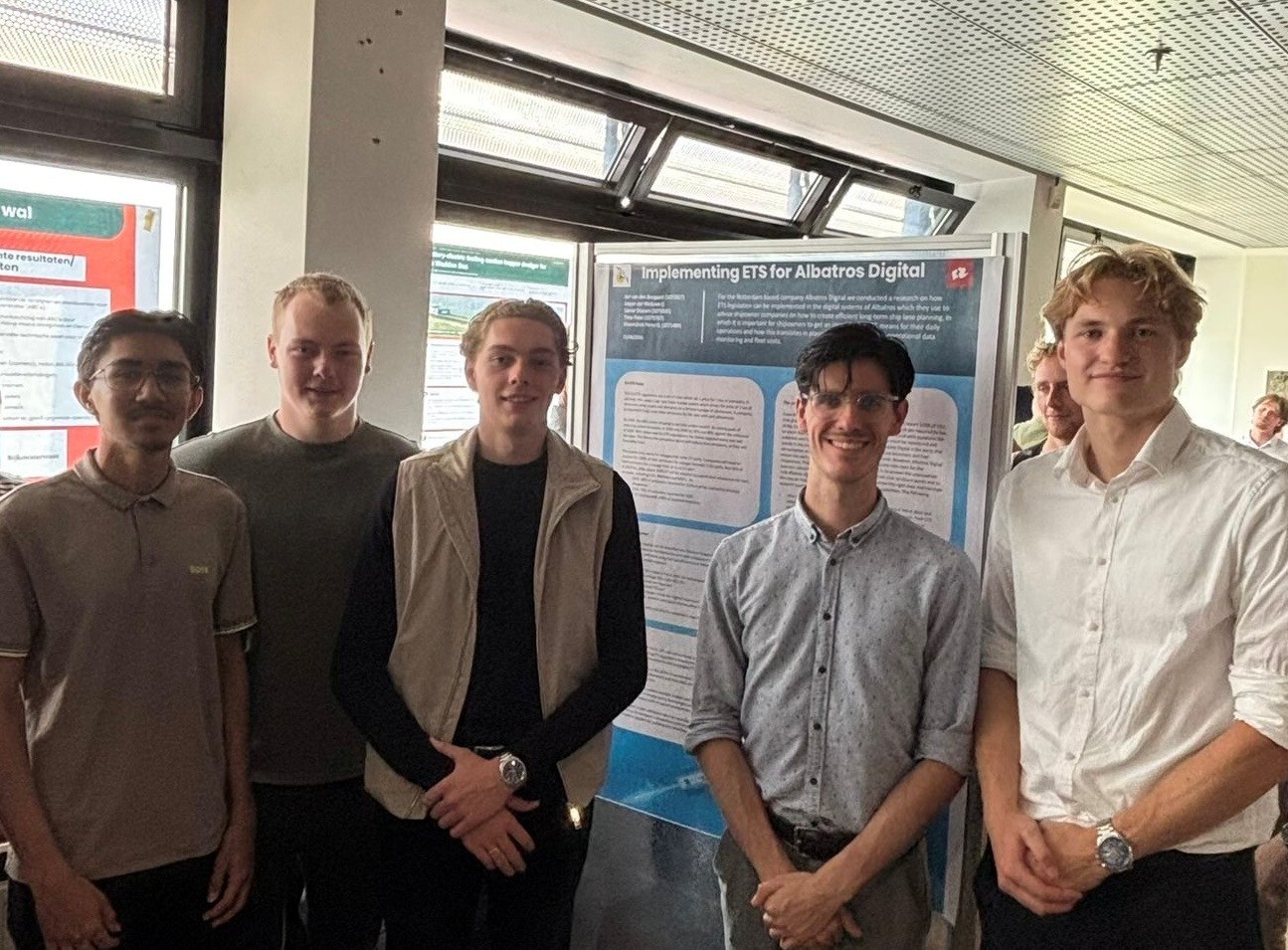
To help close that gap, Albatros Digital partnered with five students from Rotterdam University of Applied Sciences (Rotterdam Mainport Institute) for a Professional Innovation (PI) project. Their assignment: translate the EU ETS regulation for maritime transport into a clear, usable cost calculation model, and explore how it could be built into Albatros Digital's fuel consumption and simulation software.
What is the EU ETS for shipping?
The EU ETS requires shipowners to surrender emission allowances (EUAs) corresponding to a share of their verified CO2 emissions. The obligation is being phased in gradually:
- 40% of verified emissions for the 2024 reporting year
- 70% of verified emissions for 2025
- 100% of verified emissions from 2026 onward
Coverage also depends on the voyage type:
- A voyage between two EU ports is covered at 100% of emissions
- A voyage between an EU port and a non-EU port is covered at 50% of emissions
The cost itself is calculated by multiplying the CO2 emissions from a voyage (based on fuel type and quantity) by the applicable ETS coverage percentage, and then by the EUA price. As of June 2026, one EUA permit trades at roughly 80 euros.
Why the financial impact is bigger than most people expect
One of the most striking outcomes of the project was simply how much money is involved. Depending on vessel size, fuel type and trading pattern, annual ETS exposure can run from the tens of thousands of euros for smaller vessels to well over a million euros per year for larger ones.
The project also modeled the savings potential of emission-reduction measures. As one example, adding a Norsepower-style wind-assisted propulsion system to a single crude oil tanker was estimated to save between roughly 650,000 and 980,000 euros per year in ETS allowance costs alone, depending on whether allowance prices sit at the low (70 euros per tCO2), average (85 euros per tCO2) or high (105 euros per tCO2) end of current market scenarios, on top of separate fuel cost savings. For a general cargo ship, the same measure was estimated to save between roughly 150,000 and 225,000 euros per year in allowance costs.
These are the kinds of numbers that make ETS planning a board-level topic, not just a compliance checkbox.
How the model works
The underlying model classifies each voyage by its EU ETS coverage, then links fuel consumption and CO2 emissions to real-time EUA prices to calculate the exact allowance cost per voyage and per vessel. On top of that sits scenario analysis: comparing outcomes under different allowance price levels, testing the payback period of measures like wind-assisted propulsion, and weighing potential ETS savings from alternative routing against the added distance, time and compliance risk involved.
Together, these building blocks turn ETS cost estimation from a manual, spreadsheet-driven exercise into something that can run as a built-in feature of a fleet simulation platform.
What this means for Albatros Digital
This research feeds directly into Albatros Digital's ongoing work on fuel consumption and voyage simulation tools. The next step is to build on this foundation to give shipowners a decision-support view that shows, for any given vessel or route, what a voyage will cost in ETS allowances today, and how that cost could change under different fuel-saving measures, routing choices, or allowance price scenarios.
For an industry facing rising carbon costs and tightening regulation, having that kind of clarity, before a voyage is even sailed, is quickly becoming essential rather than optional.
Interested in how EU ETS costs affect your fleet, or want to know more about our simulation tools? Get in touch with the Albatros Digital team.
Keywords: EU ETS shipping, EU Emissions Trading System maritime, EU ETS cost calculation, shipping carbon costs, EUA allowance price, maritime decarbonization, wind propulsion ROI shipping, ETS compliance shipowners..