
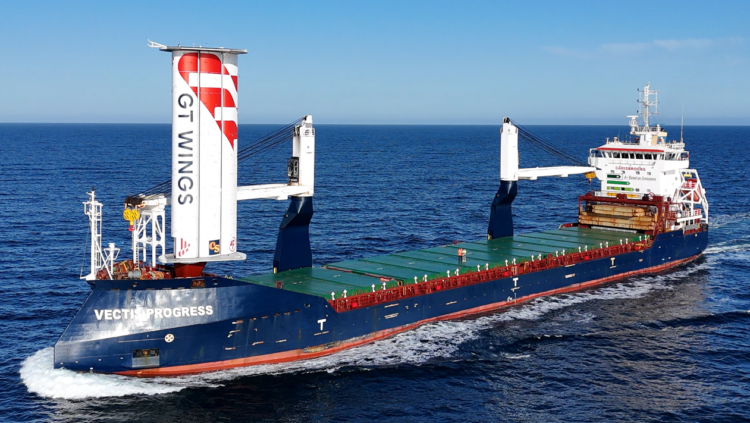
When the Numbers Agree: How Carisbrooke Shipping and AlbatrosDigital Verified a Wind Propulsion Retrofit, Together
August 2026
Every wind propulsion retrofit comes with a promised saving. On the Vectis Progress, Carisbrooke Shipping didn't want to just take that promise on faith, they wanted it independently checked, with a result both the shipowner and the OEM could agree matched reality. That fits how Carisbrooke operates: a fleet already built around energy monitoring and performance data, with a track record of putting that data to work rather than just collecting it.
Carisbrooke operates the vessel. GT Wings supplied the retrofit. AlbatrosDigital was brought in as an independent third party to measure what the system delivered, using data from both sides rather than either one alone.
Building the baseline from real data
The Vectis Progress has years of history sailing without the wing, and during the demonstration voyages themselves, the crew ran a structured on/off test: the wing flying in some periods, stowed in others, under matched conditions. That gave two real datasets to compare, rather than one measured state and one assumption.
Using the vessel's own operational history, AlbatrosDigital calibrated a physics-informed performance model of the ship sailing without the wing, and combined it with high quality weather data to describe the conditions each voyage actually sailed through.
Getting as close to reality as the data allows
The ship's own sensors, the weather data, the crew's logs, and the model itself each carry their own version of what happened out there, and none of them is a perfect record of reality. Every performance model is an attempt to get as close to that reality as the data allows.
That's part of why AlbatrosDigital builds its models on a physics-based foundation rather than a purely data-driven one. Because the model is grounded in how a ship actually behaves, physically, it has a built-in way of catching data that doesn't fit, a sensor glitch, a weather reading that doesn't match conditions, a stretch of noisy telemetry, and correcting for it rather than absorbing it as if it were real. That's also what let the model hold both the shipowner's operational history and GT Wings' on/off test data without either one distorting the other.
Before looking at the wing's contribution, AlbatrosDigital tested the baseline model against voyages it hadn't seen before, comparing what it predicted to what the ship's own fuel and power meters actually recorded. The match was close and consistent, which is what made the later wing measurement a real comparison rather than a guess resting on an unproven model. Against that baseline, the comparison did find a measurable fuel saving while the wing was flying, one that held up under more than one weather data source.
A result more than one party could agree on
Carisbrooke, GT Wings, and AlbatrosDigital all worked from the same data, the same baseline, and the same test structure. As Capt. Simon Merritt, Carisbrooke's Senior Fleet Manager, put it after reviewing the results: "it's good to have validation from a completely independent source which can be used to promote especially new technology."
"AlbatrosDigital's analysis, validated by shipowners, demonstrates the real-world impact of the technology, with the vessel data and AirWing™ working together as an integrated system to increase ship optimisation and reduce fuel consumption," adds George Thompson, CEO of GT Wings.
That shared ground, everyone working from the same evidence rather than three separate versions of events, is what let a shipowner and an OEM both stand behind the same result.
Topics:
Wind Propulsion
- Retrofit
- Performance Verificatie
- Case Study
- Duurzame Scheepvaart
- Vessel Performance Modelling